Friday, August 20, 2010
New Beginnings and Endings?
Hello Everyone,
Not that the WFO blog has been particularly busy for the past few...um...years, but I fear it is about to become even less so. The reason is that the WFO family is about to move to East Asia for a four-year term doing Christian cross-cultural work. Be praying for us, please, and feel free to shoot me an email if you'd like to hear more about what we're up to.
I'm a little sad that I didn't finish the Bible blogging project, but I'm not totally ruling out the possibility of coming back to it when I have more time. To all my many conversation partners in this journey, I offer heartfelt thanks!
Click Here to Continue Reading this Post...
Not that the WFO blog has been particularly busy for the past few...um...years, but I fear it is about to become even less so. The reason is that the WFO family is about to move to East Asia for a four-year term doing Christian cross-cultural work. Be praying for us, please, and feel free to shoot me an email if you'd like to hear more about what we're up to.
I'm a little sad that I didn't finish the Bible blogging project, but I'm not totally ruling out the possibility of coming back to it when I have more time. To all my many conversation partners in this journey, I offer heartfelt thanks!
Click Here to Continue Reading this Post...

Sunday, January 03, 2010
The God Who Takes Sides

I suppose I'll break my months of blog silence to do another movie review. I really can't resist, since Avatar brings out so many scriptural themes for me that I've addressed on this blog. Since I discuss major themes in depth, this will probably be a "spoiler" review. If you didn't want to know that the good guys win in the end, read no further! It probably would make more sense reading all this if you'd already seen the movie anyway.
The movie does an amazing job with seamlessly integrating 3D generated characters with live actors. And the artistic accomplishment really is breathtaking. By the way, please allow me a brief tangent. As someone who knows at least a little bit about computer graphics (read: master's degree), it is a little annoying to hear viewers praising the computer technology for works of art like this. It's as if someone, upon seeing Michelangelo's David, lauded the amazing developments in renaissance stone quarrying and the innovative toolsmithery of Florentine sculpting chisels. Yes, their work is important - especially insofar as Michelangelo might have needed people to develop new tools especially for him. But the vast bulk of the praise should go to the artists - for their vision, and for the long long hours of meticulous work! Every bit of terrain, every character, every glorious fantastic landscape shot represents weeks of work by artists: drawing concepts on paper, sculpting in 3D, painting with textures, carefully crafting the right lighting, rigging the characters for animation with skeletons, bringing them to life with motion capture combined with traditional keyframe animation techniques, and sending it all back to the drawing board after intense critiques. The brilliant technical work of the computer toolsmiths who work alongside them also deserves high praise, and none of this would be possible without the hardware architecture that gives us better materials each year. But to hear some people talk, you'd think the computer did all the work. Folks seem to imagine that technology involves pushing a button and getting the computer to spit out breathtaking images of cinematic art. It just ain't like that.
Anyway, the story is basically Dances with Wolves in space - which you can get from viewing the trailer. The human presence arrives at the planet Pandora in the form of a mining expedition for some Earth-based corporation. The expedition includes a private army to oversee the mining efforts. The alien natives (the Na'vi) have the beliefs, values, and culture similar to many of the indigenous North American tribes who were forced off their land by, well, us ethnically English North Americans. In this movie, the humans also want some "Unobtainium" lying conviniently under the Na'vi's sacred giant tree dwelling, so the Na'vi need to go.
The technologically superior humans also know how to create Na'vi bodies and drive them around remotely as "avatars". Thus Jake, the protagonist, infiltrates the tribe to gain intelligence on them. However, as he is immersed in their tribal way of life (with all its pantheism and reverence to the land), he becomes more and more sympathetic to them. Finally, Jake decides to join the Na'vi, and help them fight off their cruel invaders. By the end of the movie, we are all cheering as the brave, spiritual, noble savages fight off our godless technological behemoths, and avenge us for the cruel ravaging of their homeland and loved ones.
As I sat in a theater built atop the lands of displaced peoples, I couldn't help but think of Jesus' words:
Woe to you, scribes and Pharisees, hypocrites! For you build the tombs of the prophets and decorate the monuments of the righteous, saying, ‘If we had lived in the days of our fathers, we would not have taken part with them in shedding the blood of the prophets.’ Thus you witness against yourselves that you are sons of those who murdered the prophets. Fill up, then, the measure of your fathers. You serpents, you brood of vipers, how are you to escape being sentenced to hell? Therefore I send you prophets and wise men and scribes, some of whom you will kill and crucify, and some you will flog in your synagogues and persecute from town to town, so that on you may come all the righteous blood shed on earth, from the blood of innocent Abel to the blood of Zechariah the son of Barachiah, whom you murdered between the sanctuary and the altar. Truly, I say to you, all these things will come upon this generation.I don't have the wisdom to truly say where we may be filling up the measure of our fathers. It takes a lot of clarity and vision to judge these things rightly. From what I understand, it seems to me that the destruction of the Appalachian mountains and the devastation of the communities thereof might be a step in that direction. Regarding past atrocities, I realize that people rightly weary of guilty feelings about things we didn't do, as well as reparations for sins of their fathers that seem to perpetuate and enable other problems. Repentance is something deeper than this. It involves not vilifying our fathers as if they were unrecognizable monsters (as if no noble savage ever scalped their helpless, screaming wives), nor paying indulgences to assuage our guilt, but rather seeing our face in them and theirs in ours so that we may recognize our own subtle sins that we are blind to.
This wasn't, however, the most interesting thing about the movie to me. Even more interesting was James Cameron's praising of the Na'vi's pantheistic religion as the root of their harmony with nature. I don't know his religious and political views, but I'd venture a guess that Cameron is socially liberal and would perhaps describe himself as "not religious, but spiritual". He probably would decry the "intolerance of Abrahamic religions" in contrast to the richer spirituality of the noble savage. I'm totally stereotyping, and feel free to call me out if I'm missing the mark. But if this is true (and I'm almost certain my prejudice is correct), then I don't know if I've ever seen a more unintentionally ironic movie as James Cameron's Avatar.
In a moving scene, Jake prays to Eywa and the Tree of Souls for the salvation of the Na'vi. Neytiri comes up behind him and says that this won't work - Eywa doesn't take sides, as no true pantheistic deity ever would. Russ Douthat does a great job in this New York Times editorial in questioning the comfort of this pantheism, but I don't think he quite sees the full irony of James Cameron's movie. For, despite all his best efforts at lip service to pantheism, the author of Avatar is telling a fundamentally Judeo-Christian story.
If Eywa doesn't take sides, then the God of Avatar is none other than the Lord, a God merciful and gracious, slow to anger, and abounding in steadfast love and faithfulness, keeping steadfast love for thousands, forgiving iniquity and transgression and sin, but who will by no means clear the guilty, visiting the iniquity of the fathers on the children and the children's children, to the third and the fourth generation. The God of this movie is a God who has shown strength with his arm; he has scattered the proud in the thoughts of their hearts; he has brought down the mighty from their thrones and exalted those of humble estate. He is near to the Na'vi when they call on him. When in the time of their suffering the Na'vi cried out to him, he heard them from heaven, and according to his great mercies he gave them a savior who saved them from the hand of their enemies. His servant was slow of speech and tongue; he had no form or majesty that they should look at him, and no beauty that they should desire him. He was despised and rejected by his people when he sought to warn them of the folly of their ways, and strung up on a tree. He was then left for dead. But then before all the people he was revealed in glory, that at the name of Jake all the Na'vi would bow, and every tongue confess that he is their savior. In him their arrows would slay gunships, like David laying low the giant. The proud and the powerful would be cast down, and the meek would inherit Pandora.
Folks, I don't intend any insult to pantheists. Their view of the world has coherence to it; it rings true to much experience of the natural world. But this is simply isn't the sort of story true pantheists (as opposed to PINOs) tell. Watching Avatar isn't, for instance, like watching the haunting, beautiful, and deeply Buddhist (and therefore, to a Christian, alien, bewildering, and utterly unredemptive) movie Spring, Summer, Autumn, Winter... and Spring. But this story is an awful lot like the stories we read in the Bible, over, and over, and over again.
Click Here to Continue Reading this Post...
Sunday, August 02, 2009
Doubt and Faith

My wife and I saw John Patrick Shanley's "Doubt" tonight - an excellent movie based on a presumably excellent play. The movie is set in a Catholic school in 1964, where a nun suspects that a priest is having an inappropriate relationship with an alter boy. It's hard to do the movie justice in this simple description - how we grow to initially hate the harsh nun and sympathize with the priest, and then grow to suspect the priest, and finally are left with doubts about the very possibility of certainty in our convictions. When it was over, my wife and I were drawn into an hour of intense conversation about faith and doubt, which I think (judging from this interview at Christianity today) is precisely what the author intended. I don't know that I recall ever seeing a move where I might fundamentally disagree with the premise, and yet am so grateful for the way the issues were raised that I want to recommend it to others.
I mention it here because honesty with my doubts has been a very real theme for this blog. So Shanley's message on one level is something I heartily appreciate. Yet I think there is also something very important missing, leaving what remains potentially insidious. Consider Shanley's article in the LA Times concerning his play:
There is an uneasy time when belief has begun to slip, but hypocrisy has yet to take hold, when the consciousness is disturbed but not yet altered. It is the most dangerous, important and ongoing experience of life. The beginning of change is the moment of Doubt. It is that crucial moment when I renew my humanity or become a lie.I know exactly what Shanley is talking about. I grew up an evangelical, with a sprinkling here and there of fundamentalism. We most certainly weren’t fundamentalists – by which I mean those who think drinking is a sin, read only the KJV, sing only old hymns, and are afraid of nearly every bit of modern culture as being from the devil. But I was raised in an evangelicalism that assumed a rather rigid inerrancy of the Bible, and thus often (though not always) insisted on things like literal six-day creationism.
Doubt requires more courage than conviction does, and more energy; because conviction is a resting place and doubt is infinite; it is a passionate exercise. You may come out of my play uncertain. You may want to be sure. Look down on that feeling. We've got to learn to live with a full measure of uncertainty. There is no last word. That's the silence under the chatter of our time.
There was, in this, a subtle fear. The rock of our faith was the truth of the Bible, and with it came a fear that the picture the Bible painted might not be true. A single inaccuracy, a single contradiction, and the whole thing would collapse like a house of card (or a house built foolishly on the sand). So, for instance, evolution had to be false – otherwise everything we believed in was false.
This fear and anxiety would crop up every time the evolutionary picture was shown in all of its museum or textbook confidence. A similar fear would arise when I would hear about the inner workings of the brain explaining the experience of the soul. There had to be a distinction where the spiritual things broke in and were themselves unexplainable. And so these troubling things needed to be pushed out of mind.
The mind, I think, can sense dissonance and contradiction. When logic is leading to undesired conclusions, the mind can short circuit the process and warn, “don’t go there” pretty much unconsciously. Thus we can quickly be redirected to some foundational argument which we know shows evolution to be false or the spiritual to be irreducible to matter.
I remember hearing in college about there being a genuine contradiction between the New Testament’s account of David and Abiathar vs. the Old Testament one. And I was ready with a retort and rationalization – anything that preserved the inerrancy of scripture. I’ve experienced similar (though less intense) feelings and rationalizations when coming to parts of the Bible that contradicted my own theology. The thoughts needed to be put out of mind, or a quick-fix solution needed to fit right into place.
This sort of half-conscious self-deception, I’m convinced, exists almost everywhere, in almost any context. We must have coherence and consistency, and so uncomfortable things get quickly pushed aside.
So I hope no one can accuse me of being unsympathetic to Shanley. I get it; I really do. But he seems to me to be missing something crucial. He's missing the virtue that makes all this doubt worth the effort. He's missing faith.
It may sound strange to talk of faith and doubt existing in harmony, and even mutual support. To be sure, there exists a "faith" that is exactly the kind of deceptive certainty that Shanley sees enslaving us. The certainty of self-deception is like the alcoholic who refuses to believe he has a real drinking problem, or the pornographer who insists that this is an isolated personal vice that doesn't really affect his marriage. No evidence can break through such certainty, until perhaps the consequences are so severe to force the man to accept the truth. But true faith is more like the confidence of the allied soldiers in the Japanese prison camps whose desperate clinging to the dignity of their country was literally a matter of life and death. There is a faith that sets us free - yes, free even to doubt.
I felt this desire for true faith throughout my upbringing, not least at the alter call. If a man actually wants to encounter God, he doesn’t want to content himself with a mind trick. The classic yielding of a man to the will to God – of surrendering his life’s ambitions, hopes and plans – screams against self-deception. In encountering God, he is encountering reality itself. Here things are not supposed to be comfortable. Illusions are supposed to be shattered. Huge commitments are supposed to be put aside. New doubts in past certainties are to be embraced as God's own loving intervention for the salvation of our souls.
Thus faith, rightly considered, is the solution to fearful self-deception. Faith assumes that God’s truth is greater than us, that all truth is God’s truth, and that we have nothing to fear from knowing truth. In my experience, whenever my cherished beliefs are finally challenged, I have been given something richer in its place.
Here's the irony that Shanley seems to miss. When we are advised to doubt everything, to throw off all certainty whatsoever, we are left only with paralyzing nihilism and despair. We cannot use these doubts to "renew our humanity" when that humanity itself is in question. Rather, it is when we believe, deep in the core of our being, that God is good, that his will for us is good, that there is a fundamental truth, beauty, and goodness to which all things are accountable, that we are finally free to no longer hide from our doubts. Life is full of ambiguity and inconsistency; we may embrace the full measure of our smallness and ignorance. This faith gives real courage to grab hold of these uncertainties and break out of our isolating and deceptive prisons.
Lord, increase our faith! Let all that can be shaken be shaken. Let the chaff be burned away.
Click Here to Continue Reading this Post...
Monday, July 20, 2009
Dante's Inferno and the Justice of God

For some light pleasure reading lately (in all my copious spare time since I never seem to blog anymore), I’ve been working my way through Anthony Esolen’s recent translation of Dante’s Inferno. Having thoroughly enjoyed Dr. Esolen’s articles in Touchstone magazine over the years (this is one of my favorites), I jumped at this chance to hear this eloquent traditional Catholic retell a medieval classic. With this edition fully illustrated by none other than Gustave Dore, what’s not to like?
Well, there is Hell, which I suppose is precisely the point. Dante’s depiction of Hell is none other than sin unmasked, where the damned receive “poetic justice”. Here they suffer not so much “for” their sins as “by” them. Those who couldn’t control their lustful desires now whirl through the air in a ferocious but aimless tornado. Those whose divisive influence split families and nations now find their own bodies sliced apart. In one of the most memorable images to me, the lukewarm in life are abandoned to the abyss between Heaven and Hell; neither will take them.
The doctrine of Hell is more unpopular and incomprehensible to people today than in past centuries. The objections are obvious and forceful. What could a person (even Hitler) ever accomplish in a few short years to actually deserve eternal torment? This insistence on measured justice resonates with my own soul, but I fear hidden within our laxity is a trivialization of the lives we live and the people we become. There are no insignificant moments or choices - for all we know with modern science, the only real meaning in the entire universe lies within them. And what a universe is man! Somehow I know that there truly is a sense in which the slightest impiety to God or callousness to a neighbor from such a magnificent creature must merit everlasting fire prepared for the Devil and his angels. There is an ironic dignity to Hell - that the heart of man really is infinite, and thus accomplishes heights of good and depths of evil beyond the tepid expectations of modern culture. I revere humanity too much to be a universalist.
But there is something that deeply troubles me about the Inferno, and yes, even about Dr. Esolen’s commentary. We begin to get hints of it in Dr. Esolen’s introduction:
Now it is one thing to analyze what justice is: the giving of each his due (as Dante, following Aristotle, would have said), or the treating of everyone identically (as with less complexity and a shakier hold on human affairs we ourselves would say). It is another thing to hunger and thirst for justice, and to put the expression of one’s hunger and thirst under such severe artistic restraints that their well-directed force causes one’s readers to hunger and thirst for justice too.“Blessed are those who hunger and thirst for righteousness, for they will be satisfied”, and thus St. Thomas Aquinas said that one of the pleasures of heaven is seeing the punishment of the damned. Therefore, a true hunger and thirst for justice is a hunger for Hell. Taking a cue, I think, from the scripture’s language about the divine wisdom, Dante inscribes these famous words on the gates of Hell:
I am the way into the city of woe,Before all worlds, God made Hell, and saw that it was good? Here I’m beginning to squirm - there is something about all this that doesn’t seem quite right. Is not Hell the very stronghold whose gates the Church was to knock down? Dante pays lip service to Christ’s descent into Hell, but here he only skims the surface to pull the Old Testament saints from Limbo. After all, if Hell ain’t broke, Jesus don’t need to fix it.
I am the way into eternal pain,
I am the way to go among the lost.
Justice caused my high architect to move:
divine omnipotence created me,
the highest wisdom and the primal love.
Before me there were no created things
but those that last forever - as do I.
Abandon all hope you who enter here.
If Hell is the justice of God we should long for, what should our attitude be toward the damned? If Dante is to be any guide, we are to suppress our natural weakness of mercy and look upon them with the cold satisfaction that justice is being done. After all, are we more merciful than God? Over and over again, Dante is encouraged to harden his heart toward those in Hell, that his heart may reflect the heart of God.
There is a passage early on in the Inferno, where Dante observes a formerly arrogant ruler wallowing in a sea of filth with countless others. The man tries to grab the boat Dante and Virgil ride, and is shoved back into the muck.
“Teacher, I’ve got a hankering,” said I,Good to satisfy indeed. For Dante’s logic seems inexorable to me:
“to see them dunk that spirit in this swill
before we leave the lake and disembark.”
And he replied, “You will enjoy your fill
before the farther beach comes into sight.
Such a desire is good to satisfy.”
You have heard that it was said, ‘Love your enemies and pray for those who persecute you’ But I say to you, love the saints and hate the damned, so that you may be sons of your Father who is in heaven. For he exalts the good to paradise and condemns the evil to perdition.The Jewish martyrs in the book of Maccabees hurled insults at their tormentors, looking forward for the day when God, in his justice, would avenge their blood. But Jesus prayed for their forgiveness, as did St. Stephen following in his footsteps. Is the love and mercy of God something temporary - a matter of economy for the present dispensation while we see through a glass darkly? May it never be!
The problem with Dante’s justice in the Inferno is that it doesn’t see beyond justice as “an eye for an eye and a tooth for a tooth”, or “the giving of each his due”. The justice we are to long for in Christ is a higher justice than this - not of equality or retribution, but of restoration. For the Lord himself says:
Have I any pleasure in the death of the wicked, declares the Lord God, and not rather that he should turn from his way and live?Did Abraham content himself with the justice of God when he heard the news about Sodom? Did Moses when it was announced that Israel would be destroyed? No, my soul, there must be no satisfaction with Hell. I said at the outset that I am not a universalist - I reject any trite doctrine that says all will be saved. But I absolutely hope that all may be saved; I pray that all may be saved; I hunger and thirst, not for everyone to receive their due, but for all things to be made new.
In closing, I’ll see Dante’s St. Thomas Aquinas, and raise him St. John Chrysostom on Hell and its just claim upon men in taking its due:
He destroyed Hell when He descended into it.
He put it into an uproar even as it tasted of His flesh.
Isaiah foretold this when he said,
“You, O Hell, have been troubled by encountering Him below.”
Hell was in an uproar because it was done away with.
It was in an uproar because it is mocked.
It was in an uproar, for it is destroyed.
It is in an uproar, for it is annihilated.
It is in an uproar, for it is now made captive.
Hell took a body, and discovered God.
It took earth, and encountered Heaven.
It took what it saw, and was overcome by what it did not see.
O death, where is thy sting?
O Hell, where is thy victory?
Christ is Risen, and you, o death, are annihilated!
Christ is Risen, and the evil ones are cast down!
Christ is Risen, and the angels rejoice!
Christ is Risen, and life is liberated!
Christ is Risen, and the tomb is emptied of its dead;
for Christ having risen from the dead,
is become the first-fruits of those who have fallen asleep.
Click Here to Continue Reading this Post...
Thursday, November 06, 2008
The Kings of the Earth and the Lord's Annointed (Revelation 2-5)
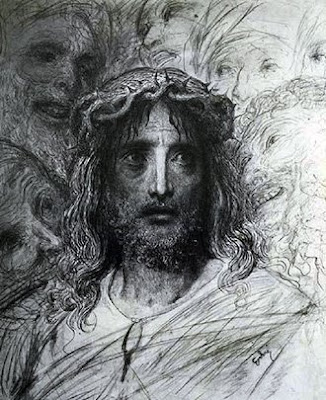
The church in John’s day is not unlike the church in many countries of the world today, and throughout history. Christians exist in empires who unashamedly trumpet their authority to rule the world as they see fit. When the church is not being actively persecuted, it is marginalized. They simply don’t matter. It is this church – the suffering and insignificant church of the first century – who first receives John’s vision of Jesus, “the ruler of kings on earth.”
To these churches, John transcribes seven letters with one message. Some are sterner than others, but the thrust is the same. Here’s the letter to Thyatira:
I know your works, your love and faith and service and patient endurance, and that your latter works exceed the first. But I have this against you, that you tolerate that woman Jezebel, who calls herself a prophetess and is teaching and seducing my servants to practice sexual immorality and to eat food sacrificed to idols. I gave her time to repent, but she refuses to repent of her sexual immorality. Behold, I will throw her onto a sickbed, and those who commit adultery with her I will throw into great tribulation, unless they repent of her works, and I will strike her children dead. And all the churches will know that I am he who searches mind and heart, and I will give to each of you according to your works. But to the rest of you in Thyatira, who do not hold this teaching, who have not learned what some call the deep things of Satan, to you I say, I do not lay on you any other burden. Only hold fast what you have until I come. The one who conquers and who keeps my works until the end, to him I will give authority over the nations, and he will rule them with a rod of iron, as when earthen pots are broken in pieces, even as I myself have received authority from my Father. And I will give him the morning star. He who has an ear, let him hear what the Spirit says to the churches.’There’s recognition of their works and perseverance, and stern warnings against their complacency and compromise. The church is implored to stick it out under pain just a little longer until the Lord comes. The church that conquers will be given authority over the very nations where it now suffers – to smash them into bits.
The number seven is the number of creation. It is used in scripture to imply “fullness” and “completion”, and so I think it no stretch whatsoever to understand this urgent message sent to “seven churches” as meant for the entire church. If we mean to take John’s unmistakable urgency seriously, then let it be clear - these letters are to us. It is we who must persevere amidst empires who are glad to run the world in rebellion against God and oppression of man. It is we who are tempted to compromise and collude with the destructive idolatry that we find ourselves in. It is we who are urged to conquer, and dash the nations into pieces with a rod of iron.
So, what are we waiting for? Time to strap on our swords and crush our enemies for the kingdom of God! But not so fast. Unless we are to make the same mistake as the Jews in Jesus’ day, we need to be careful to understand that the ruler of kings on earth whom we serve has radically redefined what it means to conquer and wield authority, and given us very counter-intuitive stories about how his kingdom comes.
The kings of the Gentiles exercise lordship over them, and those in authority over them are called benefactors. But not so with you. Rather, let the greatest among you become as the youngest, and the leader as one who serves. For who is the greater, one who reclines at table or one who serves? Is it not the one who reclines at table? But I am among you as the one who serves.And again:
He said therefore, “What is the kingdom of God like? And to what shall I compare it? It is like a grain of mustard seed that a man took and sowed in his garden, and it grew and became a tree, and the birds of the air made nests in its branches.” And again he said, “To what shall I compare the kingdom of God? It is like leaven that a woman took and hid in three measures of flour, until it was all leavened.”And again:
Truly, truly, I say to you, unless a grain of wheat falls into the earth and dies, it remains alone; but if it dies, it bears much fruit.Lest we have any doubt of the means to the end, John gives us a vivid glimpse into the heavenly reality behind the world. He sees a scroll of the purposes of God sealed up, with none worthy to take and reveal. It is then announced that the “lion” of the tribe of Judah has conquered and is worthy. But John sees not a lion, but a slaughtered lamb standing there. And then he hears the chorus:
Worthy are you to take the scroll and to open its seals, for you were slain, and by your blood you ransomed people for God from every tribe and language and people and nation, and you have made them a kingdom and priests to our God, and they shall reign on the earth.The lamb has conquered by being slaughtered. Jesus disarmed the rulers and authorities and put them to open shame, triumphing over them by his cross. The church in John’s day conquered the greatest empire in the world has ever seen, dashing its power to pieces by their patient and loving endurance to suffering and death and their willingness to forgive their enemies. And we are called to do likewise with an urgency that cannot be exaggerated.
Our king is coming, even as we speak.
Click Here to Continue Reading this Post...
Sunday, November 02, 2008
The Glory of Jesus (Revelation 1)

Revelation has an unmistakable air of both urgency and timelessness to it. Everything mentioned is said to be immanent. John is writing about “the things that must soon take place” and we are exhorted to heed his words “for the time is near.” The reader gets this sense that he will hardly have time to hear the message before it all comes to pass. And yet the message is as timeless and all encompassing as its source. The alpha and omega, the one who was, is, and is to come, tells John to “write therefore the things that you have seen, those that are and those that are to take place after this.”
This must surely challenge some common evangelical attitudes towards Revelation. On the one hand, the book is thought to be written for people a long time ago – these seven churches in the early days. On the other hand, the book is thought to be about the things that will happen at the end of time, and of use largely in preparing us in the event that we are living in the last days. Yet the book itself seems to make very little distinction between what was, what is, and what is to come. It is, after all, the same Jesus who is the center of all these things.
The book begins with a stunning vision of Jesus himself, speaking to John:
I was in the Spirit on the Lord's day, and I heard behind me a loud voice like a trumpet saying, “Write what you see in a book and send it to the seven churches, to Ephesus and to Smyrna and to Pergamum and to Thyatira and to Sardis and to Philadelphia and to Laodicea.”Depending on who you ask, there are anywhere from 300 to 600 specific Old Testament allusions in the 403 verses of Revelation. Let’s see what looking for some does for our understanding of the passage above.
Then I turned to see the voice that was speaking to me, and on turning I saw seven golden lampstands, and in the midst of the lampstands one like a son of man, clothed with a long robe and with a golden sash around his chest. The hairs of his head were white, like white wool, like snow. His eyes were like a flame of fire, his feet were like burnished bronze, refined in a furnace, and his voice was like the roar of many waters. In his right hand he held seven stars, from his mouth came a sharp two-edged sword, and his face was like the sun shining in full strength.
When I saw him, I fell at his feet as though dead. But he laid his right hand on me, saying, “Fear not, I am the first and the last, and the living one. I died, and behold I am alive forevermore, and I have the keys of Death and Hades.
A loud voice like a trumpet
Cry aloud; do not hold back; lift up your voice like a trumpet; declare to my people their transgression, to the house of Jacob their sins.
I saw seven golden lampstands,
And he said to me, “What do you see?” I said, “I see, and behold, a lampstand all of gold, with a bowl on the top of it, and seven lamps on it, with seven lips on each of the lamps that are on the top of it. And there are two olive trees by it, one on the right of the bowl and the other on its left.” “These seven are the eyes of the Lord, which range through the whole earth. These are the two anointed ones who stand by the Lord of the whole earth.”
And in the midst of the lampstands one like a son of man
Behold, with the clouds of heaven there came one like a son of man, and he came to the Ancient of Days and was presented before him
Clothed with a long robe and with a golden sash around his chest
I will clothe him with your robe, and will bind your sash on him, and will commit your authority to his hand. And he shall be a father to the inhabitants of Jerusalem and to the house of Judah.
The hairs of his head were white, like white wool, like snow. His eyes were like a flame of fire
As I looked, thrones were placed, and the Ancient of Days took his seat; his clothing was white as snow, and the hair of his head like pure wool; His throne was fiery flames; its wheels were burning fire. A stream of fire issued and came out from before him; a thousand thousands served him, and ten thousand times ten thousand stood before him; the court sat in judgment, and the books were opened.
His feet were like burnished bronze, refined in a furnace
His body was like beryl, his face like the appearance of lightning, his eyes like flaming torches, his arms and legs like the gleam of burnished bronze, and the sound of his words like the sound of a multitude.
His voice was like the roar of many waters
Ah, the thunder of many peoples; they thunder like the thundering of the sea! Ah, the roar of nations; they roar like the roaring of mighty waters!
From his mouth came a sharp two-edged sword
For the word of God is living and active, sharper than any two-edged sword, piercing to the division of soul and of spirit, of joints and of marrow, and discerning the thoughts and intentions of the heart.
His face was like the sun shining in full strength
And after six days Jesus took with him Peter and James, and John his brother, and led them up a high mountain by themselves. And he was transfigured before them, and his face shone like the sun, and his clothes became white as light.
When I saw him, I fell at his feet as though dead. But he laid his right hand on me, saying, “Fear not”
When the disciples heard this, they fell on their faces and were terrified. But Jesus came and touched them, saying, “Rise, and have no fear.”
I am the first and the last
Thus says the Lord, the King of Israel and his Redeemer, the Lord of hosts: “I am the first and I am the last; besides me there is no god.”
The living one. I died, and behold I am alive forevermore
But the Lord is the true God; he is the living God and the everlasting King.
I have the keys of Death and Hades
Shall I ransom them from the power of Sheol? Shall I redeem them from Death? O Death, where are your plagues? O Sheol, where is your sting?
OK, so they’re not all Old Testament. But it does amaze me how so much is evoked by symbols which first seemed merely strange. John looks at the man Jesus, and sees the fulfillment of all of Israel’s hopes.
It is Jesus who declares to Jacob the message of the prophets. It is him who holds together the faithful of Israel in his hands. He is the one worthy to be presented to the ancient of days. In his authority he holds Jerusalem in his hands like a father. When we look on his face, we see nothing less than the ineffable glory of the invisible God. He is the shining man Daniel saw crossing the river, while in captivity in Babylon. His voice drowns out the clamor of nations who assert their own power to rule the Earth. From his mouth comes the very word of God, piercing the heart and soul of man. In him the fullness of the glory of God lives, and shines brighter than we can look at. And yet he is compassionate, and elevates us with him in his glory. Jesus is to be seen as nothing less than the God who was and is – by his resurrection he proves that he has life in himself, and will endure forever just as we know God does. He is the conqueror of Death, and the plunderer of Hades who have hitherto held his people in captivity.
Behold, the man.
Click Here to Continue Reading this Post...
Monday, October 27, 2008
Blogging Through Revelation

In a rather sharp break from the momentum of this project, I’m going to blog through the book of Revelation. It’s a less than ideal time to do it, since I’m only now about to reach some of the key Old Testament books that Revelation most often alludes to (Zechariah, Ezekiel, Isaiah, and Daniel). The book is deeply symbolic and very complex, and I had thought to wait until I had gone through the entire Bible to sum it all up in this last majestic volume.
However, I’m teaching a study on the book in our church small group, so now is the time that I have it on my mind. If I wait 'til I finish the rest of the Bible, I may wait forever - especially at my current rate of an utter standstill. I don't want the imagined best to become the enemy of actual good.
In a study our group did on Genesis a while back, there were a few principles we tried to adhere to:
1. Use the questions of the text. Let the text set its own agenda. Rather than bringing our questions to the text, try to pick up on what questions the text itself is seeking to answer, and ask those.
2. Speak the language of the text. Suspend the need to fit every detail into a preconceived theological framework, and allow yourself to be caught up in the story, interpreting the details in its light.
This is certainly not the only way to study the Bible - or even necessarily the best way, but I think it's a particularly neglected way in evangelical Bible studies. Things seemed to work particularly well for Genesis.
Revelation is a little trickier, because its imagery depends so heavily on the rest of the Bible. But I'm offering the group a few tips that seem helpful, most of which I've shamelessly stolen from a list I found on the internet that seemed wise.
1. The book of Revelation was written to the church in its infancy which was facing a great deal of persecution. We may not be persecuted for our faith, but St. John’s church was, as have been many since, as many are today. How does this speak to a suffering and powerless people?
2. Revelation is deeply symbolic, and though the symbolism is vivid and colorful, it isn’t primarily visual. Numbers, for instance, are almost always meant to convey meaning rather than a sense of how many objects we should be picturing in our heads. What are the symbols pointing us to?
3. The more of the Old Testament you know, the better you’ll get on with Revelation. Almost 600 OT references have been picked up, most of them probably unconscious. John is just so steeped in the language of scripture that it forms a natural part of his language. What OT themes are being invoked?
4. Notice how central ‘worship’ is to this book. The heart of Revelation’s message is the victory of Christ and the sovereignty of God over all the powers of the earth. Though this was written immediately to a church facing the might of the Roman Empire, it still speaks to us because those powers still trumpet their sovereignty in our world. How are we to worship?
Here we go!
Click Here to Continue Reading this Post...
Tuesday, September 23, 2008
My Presence Will Go With You (Haggai 1-2)

I admit that it’s hard to have much perspective on the book of Haggai, having not yet gone through the return from exile in Ezra and Nehemiah. My goal in reading the prophets has been to gain perspective on the exile itself before moving on to the return, and so Haggai doesn’t exactly fit in that well at first glance. But let’s see what we can find.
The book is short and to the point. Some of the people have returned from exile back to Judah, and are managing to scratch out a meager existence for themselves in their ancestral homeland. But their thoughts are only on their own concerns. They have little energy for the things of God. And so the prophet speaks:
Is it a time for you yourselves to dwell in your paneled houses, while this house lies in ruins? Now, therefore, thus says the Lord of hosts: Consider your ways. You have sown much, and harvested little. You eat, but you never have enough; you drink, but you never have your fill. You clothe yourselves, but no one is warm. And he who earns wages does so to put them into a bag with holes . . . Go up to the hills and bring wood and build the house, that I may take pleasure in it and that I may be glorified, says the Lord.I think back to Moses pleading with the Lord to travel alongside his people:
If your presence will not go with me, do not bring us up from here. For how shall it be known that I have found favor in your sight, I and your people? Is it not in your going with us, so that we are distinct, I and your people, from every other people on the face of the earth?There is no life for the people of Israel without the abiding presence of God alongside them. There is no glory for them as a nation if they do not radiate with the glory of God. They were exiled from his presence for disobedience; how can they return and build houses for themselves if God is not to dwell once again in their midst?
Here again I’m struck with the nature of the God of Israel. This is a God who wants to live with man. He wants to elevate man to himself, and to condescend to live among them. The anger and frustration at their faithlessness is just another angle on that intense longing of God for his son to share his glory.
Click Here to Continue Reading this Post...
Tuesday, July 15, 2008
Esau Have I Hated (Obadiah)
I apologize again for the lack of posts. I'm working on a really neat side project right now that's taking up most of my spare time. But I'm not abandoning the blog.
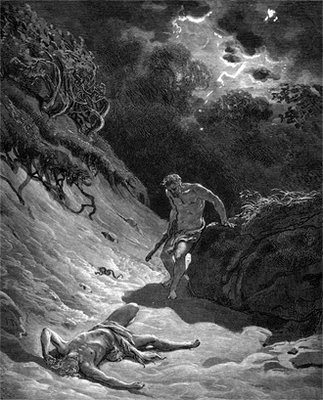
The vision of Obadiah is a short but fierce proclamation of Edom’s destruction. The justification seems simple enough. During the fall of Jerusalem, Edom sided with Judah’s enemies, going so far as to hunt down fugitives to turn over to the Babylonians. It’s wounds from a brother that bite deepest.
On the day that you stood aloof,The Lord announces his verdict, in a terrifying variation of the golden rule:
on the day that strangers carried off his wealth
and foreigners entered his gates
and cast lots for Jerusalem,
you were like one of them.
As you have done, it shall be done to you;In the end, even though Jerusalem has been plundered and Judah taken off to Israel, the Lord’s judgment will be in their favor:
your deeds shall return on your own head.
But in Mount Zion there shall be those who escape,That certainly settles the matter. Cain who murdered his brother was exiled. Esau who despised his birthright will now be dispossessed. Such is God’s faithfulness to the younger brother Israel.
and it shall be holy,
and the house of Jacob shall possess their own possessions.
The house of Jacob shall be a fire,
and the house of Joseph a flame,
and the house of Esau stubble;
they shall burn them and consume them,
and there shall be no survivor for the house of Esau,
for the Lord has spoken.
But what about Israel’s redemption? Is Israel being restored simply to gloat over those who were happy to see her down? What about Esau embracing Jacob and Jacob seeing the face of God? What about Joseph saying “you meant evil against me, but God meant it for good?”
Right now it looks to be forgotten. God’s verdict for their destruction is final and all encompassing. Unless, of course, someone with the authority to represent the people might look upon those who cast lots for his clothing and pray “Father forgive them, for they know not what they do.”
Click Here to Continue Reading this Post...
Wednesday, June 25, 2008
The Audacity of Hope (Habakkuk 1-3)
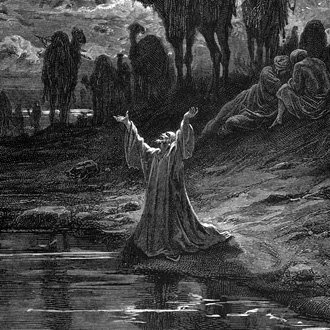
Wow, it’s been a while since my last post here. I suppose I’m doing what many readers of the Old Testament have done before me: I’ve gotten bogged down in the prophets. And these are just the “minor” prophets at that! Anyway, sorry about the title. I know it's a shameless ripoff, but it just so happens to also be a perfect title.
Hope seems to be one of the strongest themes in the Old Testament. Not optimism, mind you. Things don’t ever seem to go all that well for the people of Israel, and even the most glorious moment of their story, the exodus from Egypt, is filled with failure and judgment so severe it almost ended the story before it began. Yet every page is bursting at the seams with an unshakable hope in the goodness of God.
It is common indeed for people today to ask “where was God” when a tragedy strikes. It is even more common for eggheads like me to do so in a detached and cynical fashion about tragedy in the abstract (the problem of evil). But it makes every difference in the world whether the question is asked out of despair or hope. Indeed, those who hope can scream for God with a volume scarcely reachable by more tepid and bitter voices:
O Lord, how long shall I cry for help,Thus says the prophet Habakkuk, in the face of the idolatry and injustice of Israel. God responds by bringing the Chaldeans (or Babylonians) to be the great equalizers of a corrupt and haughty civilization. But even this “salvation” is ambiguous. The Chaldeans exploit and abuse every kingdom known to man. It is true that the poor now see the rich getting their comeuppance, but the people of Israel as a whole must struggle under their yoke. Rich and poor suffer alike.
and you will not hear?
Or cry to you “Violence!”
and you will not save?
Why do you make me see iniquity,
and why do you idly look at wrong?
So Habakkuk asks again:
O Lord, you have ordained them as a judgment,The Chaldeans may be God’s way of judging the people of Israel, but they themselves are calling down judgment on their own heads:
and you, O Rock, have established them for reproof.
Is he then to keep on emptying his net
and mercilessly killing nations forever?
Woe to him who builds a town with bloodThe wrath of man doesn’t achieve the justice of God, and so even man as God’s instrument stands condemned. Israel has failed his task of upholding the law as a light to the nations, and instead has fallen into idolatry and injustice. Babylon has failed in her task of punishing Israel justly, and instead arrogantly assumes the entire world will be her prey. This is what the Lord saw when, before the flood, the Earth was filled with violence and the intentions of man’s heart were only evil continually. No wonder the Bible speaks of God being tempted to destroy man for good.
and founds a city on iniquity!
Behold, is it not from the Lord of hosts
that peoples labor merely for fire,
and nations weary themselves for nothing?
For the earth will be filled
with the knowledge of the glory of the Lord
as the waters cover the sea.
This is all hardly grounds for optimism. So the prophet leaves optimism behind, and clings to hope instead:
Though the fig tree should not blossom,Hope looks into the blackness of utter despair and total ruin and says, with defiance, “yet I will rejoice.” Such hope isn’t sentimentality or wishful thinking. It refuses to submit to the dark facts of reality, and so changes that reality by bringing the rule of God to bear.
nor fruit be on the vines,
the produce of the olive fail
and the fields yield no food,
the flock be cut off from the fold
and there be no herd in the stalls,
yet I will rejoice in the Lord;
I will take joy in the God of my salvation.
God, the Lord, is my strength;
he makes my feet like the deer's;
he makes me tread on my high places.
Thus Noah found favor in the eyes of the Lord. Thus Abraham believed God, and it was counted to him as righteousness. Thus Moses turned the face of God back towards his rebellious people. Thus David established an everlasting kingdom. And thus the tomb of the son of David was found empty, for hope does not disappoint.
Click Here to Continue Reading this Post...

Home
Who is Oyarsa?
Contact Me
Blog the Bible
Recent Comments
Archives
- June 2006
- July 2006
- August 2006
- September 2006
- October 2006
- November 2006
- December 2006
- January 2007
- February 2007
- March 2007
- April 2007
- May 2007
- June 2007
- July 2007
- August 2007
- September 2007
- October 2007
- November 2007
- December 2007
- January 2008
- February 2008
- March 2008
- April 2008
- May 2008
- June 2008
- July 2008
- September 2008
- October 2008
- November 2008
- July 2009
- August 2009
- January 2010
- August 2010
Recommended Books